Episode 14
Mount Angeles, 1974

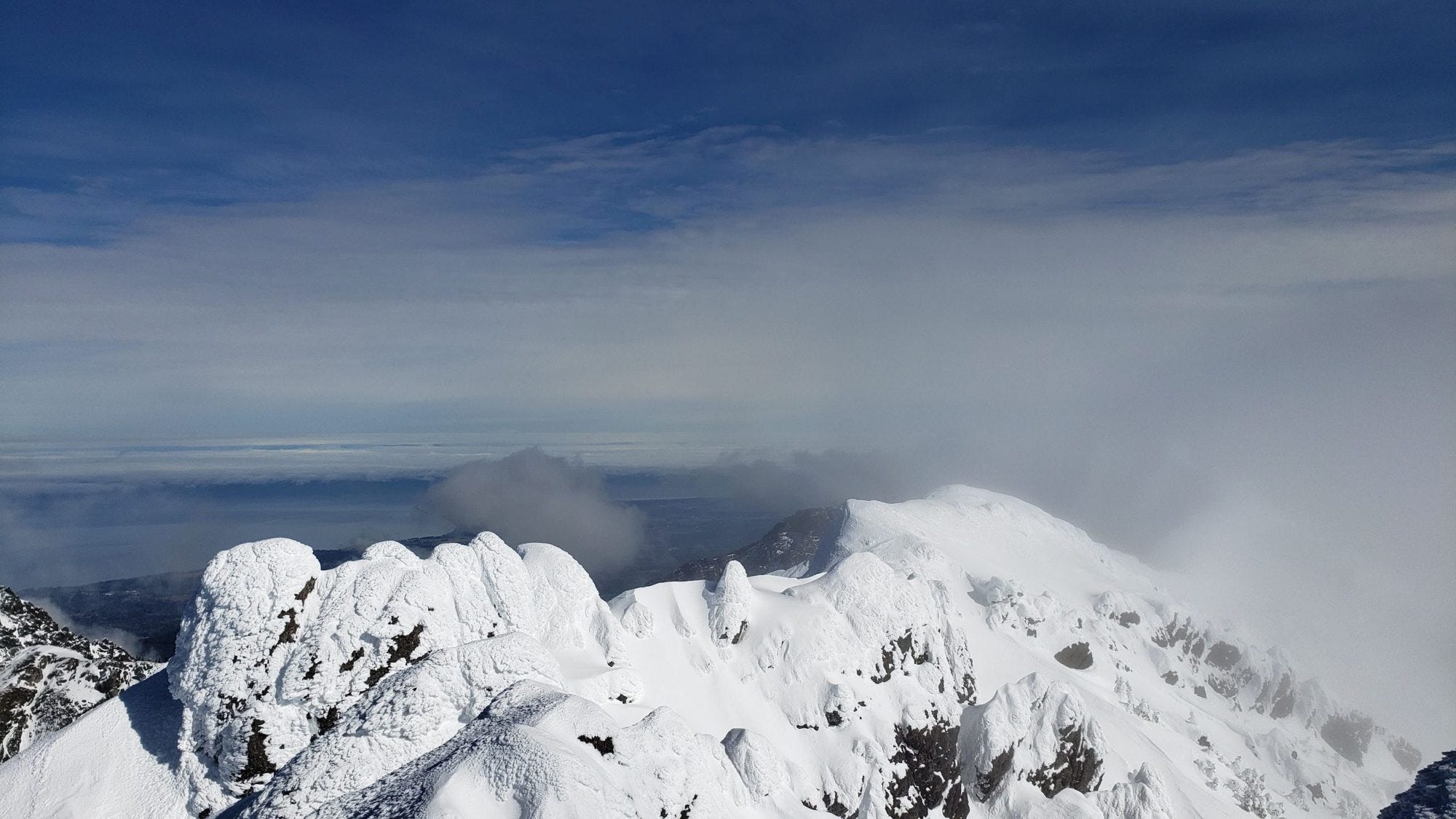
Mt. Angeles in winter. Image: Hike2Hike.com
Olympic National Park
Spring, 1974
Jerome and I parked at the Switchback trailhead on the Hurricane Ridge Road. Our destination that day was the summit of Mount Angeles, an 1800 foot climb above the parking lot. We’d arrived early that morning, and it was sunny and very cold. There was a foot of fresh snow, sparkling like gems in the early morning light. We grabbed our ice axes and day packs—mine was a Korean War era surplus metal framed rucksack, stuffed with extra clothes, water, a bit of food, a cooking pot and my backpacking stove. We also had crampons, if needed.
Both of us had hiked to the summit many times that fall by way of the Switchback Trail, which leads to a saddle or low pass on Klahanie Ridge. From the saddle, the east summit of Mount Angeles is gained by way of a rough scramble up through a shoot that requires the use of hands and feet to negotiate, but not so rough as to require roping up.
Leaving the parking lot, we climbed up toward the Saddle, passing through clusters of fragrant Alaska yellow cedar and alpine fir. Densely packed at first, the clusters become fewer and farther between as one gains elevation, giving way to wide open slopes for several hundred feet below the saddle. There was a firm layer of older snow beneath the sparkling powder on top, and we had little difficulty as we trudged upward.
Reaching the saddle, we stopped to drink some water and admired the glorious views of Steeple Rock, Mt Christie, the Bailey Range and the Elwha and Lillian River valleys. Following a finger ridge northwesterly, we ascended through the shoot and then up to the east summit. From here, the route to the west Summit is a relatively easy walk to the west along a crest that leads directly to the west Summit at 6454 feet. We wrote our names and the date in the notebook that lived in an old mailbox at the summit and retraced our steps back to the saddle.
It was by now late morning, and the temperature had warmed noticeably. It was really quite pleasant, actually. We talked about how to approach our descent from the saddle to the parking lot. We decided to use a technique called “glissade” which in the alpine sense is a controlled, seated, slide down a snowy or icy slope. One sits down, holding an ice axe high, near the head with the right hand, and lower down on the shaft with the left, diagonally across the upper body. By allowing the tip of the shaft to engage the snow, one can control the speed of a slide down an incline.
I wore Army surplus wool trousers which are less than ideal for sliding in the snow. So, I dug out my cagoule, which is a knee-length anorak. It was made of heavy waterproof nylon: just the thing for snow sliding. With my rucksack on my back, I assumed a seated position and began my sliding descent. Jerome would stand by and follow presently.
I quickly picked up speed as I slid. Almost immediately, I planted the end of my ice axe into the snow to slow down. The next thing I knew I was airborne, flying sideways, my body across the slope—my Ray-Bans flew off in a graceful arc till they disappeared in the snow. I landed and then a powerful wave seized me, throwing me ahead of a swiftly advancing slab of snow: an avalanche! As I tumbled down the slope, rolling over and over and over again, thrown ahead repeatedly by the advancing avalanche, I saw that I was heading directly toward a copse of yellow cedar. I figured I was facing serious injury if I hit those trees in the wrong way, and of course I had no control whatsoever over how I would hit them.
Tumble, tumble, tumble, then STOPPED: I’d hit a tree, right in the middle of my rucksack. I was laying on my right side, facing uphill and pinned against a tree. Instantly, my right arm and leg were trapped, immobilized in the snow. Meanwhile, snow continued to flow over and past me. Pressure was building on my chest from the weight of the snow, making it harder and harder to breathe. Presently, my left leg was immobilized. Moving my left arm back and forth like a windshield wiper, I managed to keep the snow from burying my head. Then, quiet, except for the hiss of the avalanche as it continued its ride down slope.
By now Jerome, who had gotten knocked down by, but not trapped in the slab of moving snow that I’d broken loose, was on his feet and headed my way. I don’t think I could have extracted myself without his help. Soon enough though, I was free of the snow and took stock. My sturdy aluminum cooking pot was crushed like a beer can at a college kids’ (of which I was one) party. By taking the brunt of the impact, I figured that rucksack and pot saved me from having a broken back. My Ray-Bans were gone forever. But Jerome and I made it back to the parking lot. That was good enough for me.