Episode 10
Sam's Scribing: Following in the Footsteps of a Local Pioneer

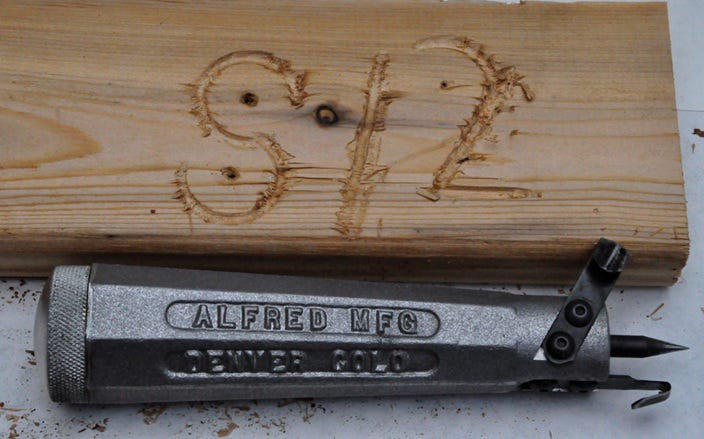
N48º04’18”, W123º38’10” (1984)
During a 1984 retracement of Section 24 in Indian Valley, we recovered a 6”x 6” Clallam County concrete monument that had for many years been used as the southeast corner the section. Unfortunately, there was no clear history in the County Engineer’s records describing just how or when this monument came to be located at this particular position. Our task this day was to tie the monument to an established traverse station located to the west, on the south edge of Highway 101. Doing so would allow us to evaluate the existing monument’s position with respect to other monuments and surveys of record. We had the instrument set up over the monument, but 21 feet to the west and obscuring the line of sight to the traverse station, was a 34” diameter fir stump with a 3-foot high growth of salal sprouting out of its flat top. George deployed his trusty machete to deal with the salal which blocked the line of sight. As he worked, clearing away the brush, bark and rotted outer layers of the stump fell away, revealing a pitch-saturated face. A closer inspection revealed evidence of axe work on the pitched-over face. Could this be evidence of the original 1879 survey?
The pitch accumulation was so thick it was difficult to figure out just what it was we were seeing. Using a rag and some chainsaw gas, we washed away the excess pitch so we could see the face more clearly. Jackpot! There were scribe marks on the face…but the stump was not an original US General Land Office (GLO) bearing tree. It failed to fit the BT calls in the GLO notes: Wrong species, wrong bearing, wrong distance, wrong size, and most importantly, wrong scribing. The stump was marked, “M. MORSE 1879,” which is NOT typical of markings made on bearing trees. We were not seeing the complete set of scribe marks as some of them had been cut off when this tree had been harvested. Still, this was no bearing tree.
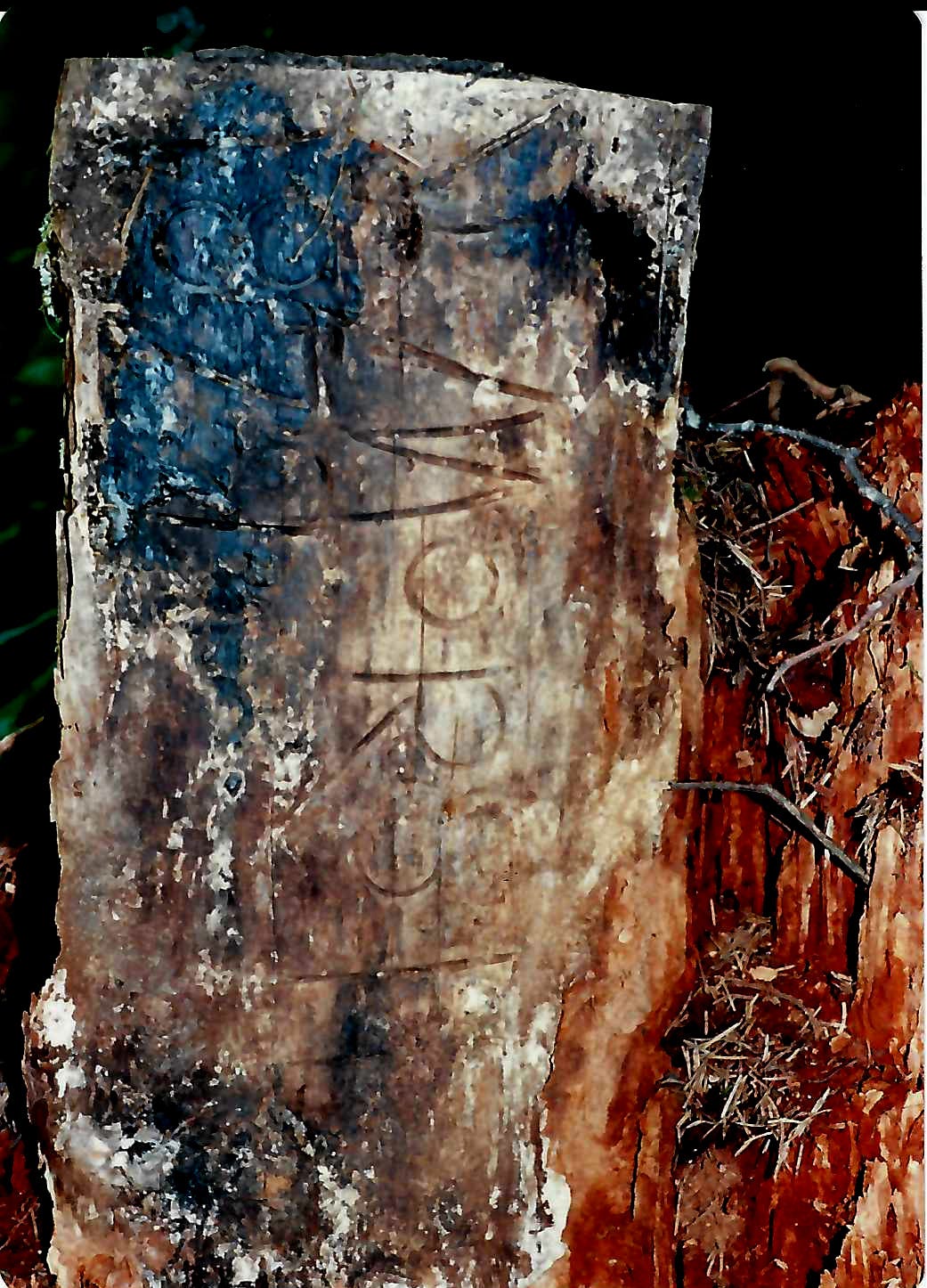
According to the GLO field notes, this corner had been monumented by US Deputy Surveyor Ross P. Shoecraft on November 3, 1879. Further research of the field notes revealed that W.S. Shaser and Fred Bullock served as Axe and Mound men on Shoecraft’s crew. In this capacity, Shaser and Bullock would have been responsible for blazing bearing trees and marking them with a scribing tool. But, Samuel Morse, whose family received patents from the federal government for land located just east of Port Angeles in 1865, 1870 and 1890, had served as one of three Chainmen on the crew. We can only guess as to why Sam scribed that fir tree on a cold November day in 1879. Perhaps he was practicing use of the scribing tool or maybe he just wanted to leave his mark on the landscape. Residents of the North Olympic Peninsula know of the Morse family and the marks they left behind: Every day thousands of us negotiate the notorious (especially in winter) Morse Creek Curves of US 101 east of Port Angeles and cross the bridge over Morse Creek, named for the family that homesteaded what is now known as Four Seasons Ranch.
Subsequent analysis confirmed that the recovered monument most likely perpetuated the original corner’s position. Even though the stump and the scribe marks we found were not associated with one of four bearing trees described in the original field notes, there was no doubt that we were walking in the footsteps of Sam Morse and his crewmates.
Surveying isn’t just about fancy electronic instruments, LiDAR or GPS. On the very best days, it’s about being in the field, following in the footsteps of those who’ve gone before us. Throw in a little applied archeological excavation and historical research that reveals forgotten links to an obscure past, as happened this day, and you’ve got the makings of a fascinating and rewarding career.
It has become a ‘first’ culture in recent decades. First to do this, first to do that. There’s something grounding that can give a sense of belonging when learning that you’re not always the first, but continuing on the path; and that perhaps the first was a hundred or a thousand years ago, only there was no YouTube or social media to document it in the moment.